

Why Modern Food Is Too Soft for Your Jaw (And What Hard Chewing Fixes)
Look at a skull from 10,000 years ago and one thing stands out: the jaw is broad, square, and the teeth line up perfectly. Look at a modern jaw and it's narrower, softer, and crowded. Same species. Different diet. The single biggest change? We stopped chewing hard food.

Why are modern jaws weaker than they used to be?
Because the modern diet asks almost nothing of them. Researchers estimate modern humans use the masticatory (chewing) system about 3–5% as much as Paleolithic humans did. Our ancestors tore into raw vegetables, tough meat, and coarse grains. We eat food engineered to dissolve.
This isn't a fringe idea. A University of Kent analysis found that children who ate more ultra-processed foods had smaller, less developed jaws, precisely because those foods are soft and require little chewing. Anthropologists have documented the same pattern across history: as diets softened after the agricultural revolution and again after the Industrial Revolution, jaws shrank while teeth stayed the same size — which is a big part of why crowded teeth and weak jawlines are so common today.
What does chewing actually do to the jaw?

Chewing loads two muscles: the masseter (the thick muscle you can feel bulge at the back of your jaw when you clench) and the temporalis (at your temple). The masseter is, pound for pound, one of the strongest muscles in the human body — but like any muscle, it only stays strong if it's worked.
The evidence for "use it or lose it" here is direct. In a controlled study, animals raised on a soft diet developed significantly smaller masseter muscle fibres than those fed a hard diet. Feeding studies have also shown that a soft diet changes the actual movement pattern and electrical activity of the jaw muscles during chewing. Less load in, less muscle out.
Can you reverse a soft-food jaw?
You can't shrink your skull back to a hunter-gatherer's — bone structure is largely set in adulthood, and no gadget changes that. Be skeptical of anything that claims otherwise. What you can do is train the muscle. Muscle responds to resistance at any age. The goal isn't to fix evolution; it's to give the masseter and temporalis the mechanical load that modern eating no longer provides.
There are three practical ways to add that load back:
| Method | How hard it works the jaw | Convenience | Best for |
|---|---|---|---|
| Eating tougher whole foods (raw carrots, nuts, jerky, tough cuts) | Moderate — depends on the meal | Easy, but hard to do consistently | A good baseline everyone should aim for |
| Standard chewing gum | Low — soft, gives out in minutes | Very convenient | Fresh breath, not training |
| Extra-hard functional chewing gum | High — dense, lasts, keeps resistance up | Very convenient — chew anywhere | Adding real chewing reps to a normal day |
| Silicone jaw resistance trainer | Highest & adjustable — progressive levels | 10 min/day, deliberate reps | Structured "training" like a gym session |
The simplest fix: put hard chewing back in your day

Whole foods are the foundation, but most people can't reengineer every meal. The easy win is to add deliberate chewing load with a tool designed for it. Ordinary gum is too soft to count as training — it's the difference between carrying a bag of shopping and lifting at the gym. A dense, extra-hard gum keeps the resistance high long enough for the muscle to actually work.


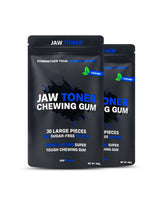
Jaw Toner Chewing Gum — Pure Mint
Extra-hard gum built as resistance training for your jaw, not a soft mint. Chew it on the commute or at your desk to add masseter reps to an ordinary day.
From $32 AUD
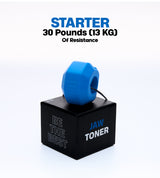
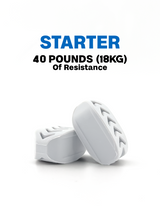
Shop the Chewing GumIf you'd rather treat it like an actual workout — controlled reps, progressive resistance levels, rest days — a silicone jaw trainer gives you more control than gum. Ten minutes a day, and you move up a level as the muscle adapts, exactly the way progressive overload works in the gym.

Jaw Toner 2.0
A silicone resistance trainer for the masseter and temporalis, with three levels so you can progress like any lift.
From $35 AUD
Shop the Jaw Toner 2.0Frequently asked questions
Does chewing hard food really make your jaw stronger?
Yes — hard chewing loads the masseter and temporalis, and muscle adapts to load. Studies show soft diets produce smaller jaw muscle fibres, and the reverse logic holds: consistent resistance keeps those muscles worked.
Will chewing gum give me a sharper jawline?
Chewing trains the muscle underneath your jawline, which is one factor in how defined it looks. It won't change your bone structure or burn fat in a targeted spot. Ordinary gum is also too soft to be real training — you need something dense and hard to create meaningful resistance.
How much hard chewing is enough?
There's no official number, but the useful comparison is the gym: short, consistent, progressive sessions beat occasional marathons. Ten minutes of deliberate resistance most days, plus tougher whole foods when you can, is a sensible routine.
Is hard chewing safe for my teeth and jaw joint?
For most people, controlled chewing is fine — it's what jaws are built for. Keep sessions reasonable rather than clenching all day, and if you have an existing jaw-joint (TMJ) condition or dental work, check with your dentist first. These are fitness tools, not medical devices.
Can adults still benefit, or is it only for kids whose jaws are developing?
Jaw bone development mostly happens in childhood, but muscle responds to training at any age. Adults train the muscle, not the bone — and that's the part that affects strength and, in part, definition.
The takeaway
Modern food is soft, and jaws are weaker for it — that's well documented, not marketing. You can't rewind evolution, but you can put hard-chewing load back into your day: tougher whole foods as a baseline, and a purpose-built tool like the Jaw Toner Chewing Gum or the Jaw Toner 2.0 to add real, consistent resistance the way your ancestors' diet used to.