

Bone answers to load
Wolff's law and Frost's mechanostat: bone remodels in response to the mechanical forces placed on it.
Foundational theory
Pre-industrial people grew wide jaws and straight teeth with no orthodontists. Their food demanded hours of hard chewing every day.
Corruccini's population studies found food toughness was the single best predictor of how well teeth fit together. Modern processed food removed nearly all of that load.
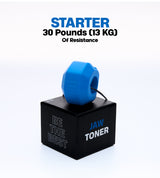
Jaw Toners puts ancestral-level chewing resistance back into your day. Ten minutes, no roots, seeds or raw meat required.
Wolff's law and Frost's mechanostat: bone remodels in response to the mechanical forces placed on it.
In dentate women, masseter thickness was a significant determinant of mandibular alveolar bone mass and thickness.
Masseter muscle strength correlated moderately with mandibular cortical bone thickness (r = 0.59).
Rats raised on soft diets developed smaller jaw muscles, shorter mandibles and reduced facial height.
A trained muscle pulling harder on its anchor points is the mechanism people extrapolate to the human jaw. It is a theory, not a promise.
Bone adaptation in adults is an area of active research and the evidence here is largely animal and correlational. We make no medical claims. Individual results vary.
Maximum bite force rose after four weeks of resistance chewing, five minutes twice daily.
Ultrasound showed masseter thickness changes with function. It behaves like any other skeletal muscle.
Of all the jaw muscles, masseter thickness was the one that correlated significantly with bite force.
Daily chewing training increased bite force in supervised trials.
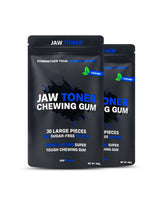
Tougher chewing gum drives higher masseter muscle activation than standard gum.
Studies measure bite force and muscle activation. Visible change depends on consistency and body fat.
The suprahyoid muscles run from your chin to the hyoid bone. They hold up everything under your jawline, and almost nothing in modern life works them.
Hard chewing and tongue-press reps are the same family of drills used in myofunctional therapy, where a meta-analysis of adult patients found roughly a 50% reduction in apnea-hypopnea index. These muscles respond to training.
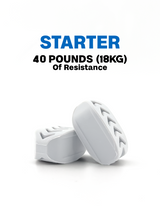
The 3.0 loads the masseter directly, from 40 up to 70 pounds of resistance. That is the muscle that sets jaw width and the line you see from the side.
Tongue, jaw and throat strength is the whole basis of myofunctional therapy, which research links to easier nasal breathing and calmer sleep.
Training your jaw is not a treatment. It does work the same muscles those programs target.
4.8 from 2,000+ reviews
Individual results vary with consistency and body fat.
Full guides for each product are one click away.
Slow vertical reps to fatigue. Ten minutes.
Fifty clean reps feel easy? Next resistance.
Side chews and tongue presses for under the jaw.
Rest day every two to three days. Muscle grows on rest.
Every trainer ships with the 45-day trial.


